We’re excited to annuance the publication of the paper entitled “Are spatial plans transformative for biodiversity and ecosystem services? Insights from seven European countries” in European Planning Studies. Developed within the Horizon Europe BioValue project, this research investigates how spatial plans can drive deep change for nature across Europe.
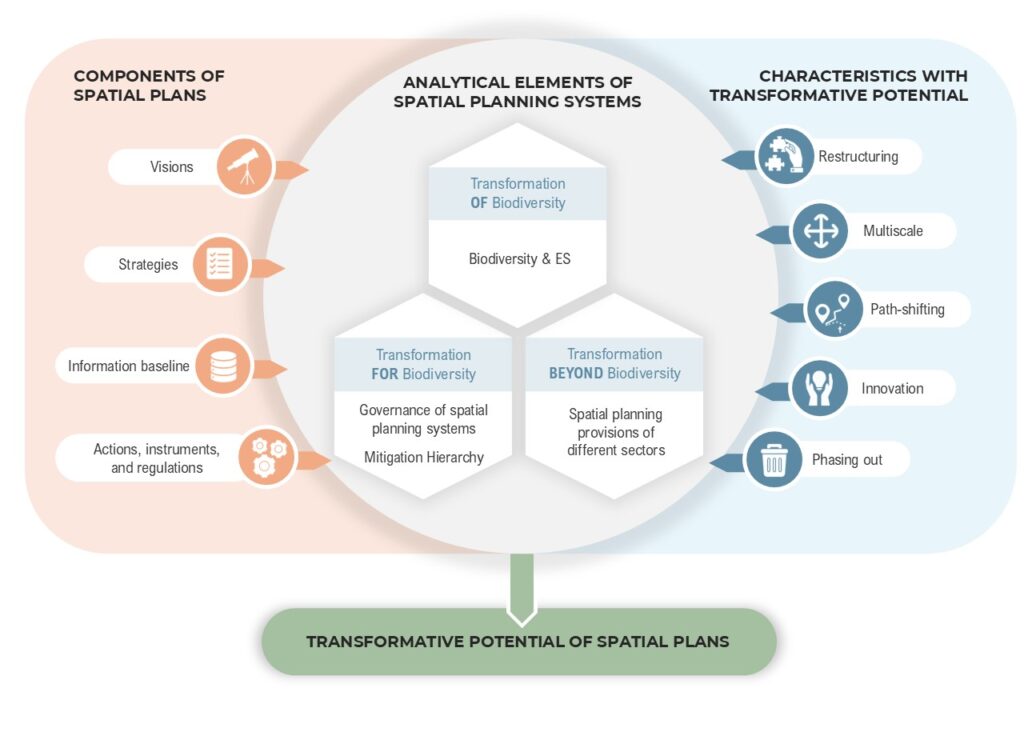
The study analysed 28 spatial plans from Italy, Denmark, Germany, Portugal, Scotland, Spain, and Switzerland. Using a theory-based assessment framework, we examined key planning components—visions, strategies, actions, and regulations—through five transformative characteristics: restructuring, multiscale integration, path-shifting, innovation, and phasing-out.
Results reveal varying degrees of transformative potential. Visions and strategies (compared to knowledge base, and actions and regulations) showed stronger commitments to change, while governance and biodiversity/ES considerations reflect emerging transformative practices. However, the mitigation hierarchy and sectoral integration remain underused. Overall, plans favour incremental restructuring over more disruptive shifts such as innovation, path-shifting, or phasing out unsustainable practices.
The study highlights critical opportunities to strengthen biodiversity-inclusive spatial planning and to reframe spatial planning systems toward long-term ecological goals.
Read the full article: https://www.tandfonline.com/doi/full/10.1080/09654313.2025.2582608



.jpg)

 I conduct research on the economic evaluation of nature-based investments, and the use of multi-criteria decision-making methods, econometric models for supporting decisions by public-private stakeholders in the sustainable urban planning of the cities. Formerly intern at the Forestry Policy and Division of the Food and Agricultural Organization (FAO), visiting scholar at SUNY College in Syracuse (USA), expert for the European Commission.
 My main research interest is the evaluation of ecosystem services supplied by Nature-based Solutions in cities and its support to spatial planning. More specifically, with the research grant I’ve been assigned I’m conducting a detailed analysis of the benefits provided by community gardens in the city of Trento.




 Based on a legal geography approach, I conduct research on the impact of planning regulations on urban development, transfer of development rights, and preservation of natural urban areas along with research on governance and approaches to public participation in planning. Formerly post-doc researcher at TU Delft and planning consultant for local planning authorities.

 I research the relations among Nature-Based Solutions (NBS), Ecosystem Services, and Urban Sustainability. Specifically, I study environmental and economic assessments of NBS making use of a systems dynamics approach. I hold academic degrees in Environmental Sciences, Architecture/Urbanism, and Landscape Ecology. In the past, I worked for a planning consultancy in the UK.
 I research the link between nature-based solutions and sustainability to support the spatial planning of sustainable cities. I worked as a research fellow at the University of Trento, Italy, mapping and assessing the ecosystem services provided by the urban green infrastructure of the city of Havana, Cuba. I hold a Master of Science in Architecture and Construction Engineering from the University of Trento, Italy.
 My research interests include sustainable urban and landscape development, especially regarding the topics of ecosystem services, urban metabolism, and circular economy. My current research activities focus on the planning of nature-based solutions in urban areas. I received my MSc in “Planning and Policies for Cities, Environment and Landscape” from the University IUAV of Venice.
 His PhD research focused Spatial planning policies to integrate climate change adaptation at local level in India. Parveen is currently a post-doc researcher at the Environmental Research Institute, University College Cork
Comments are closed